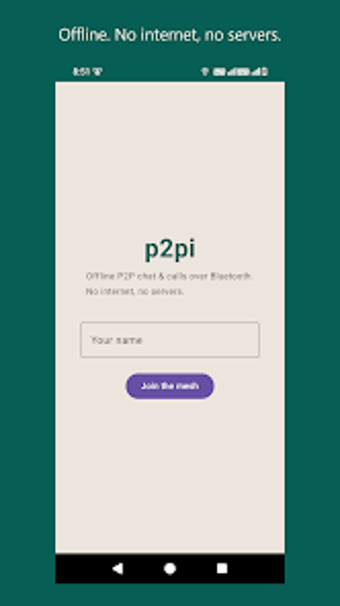
P2PI: Android peer-to-peer messaging for offline and outage scenarios
P2PI (Peer-to-Peer Infrastructure), created by Rehan Ahmed Allahwala, is an Android app for offline communication in network outages and remote locations. The app enables direct device-to-device text, voice, and video messaging using Bluetooth and mesh networking, offering private group conversations and local file exchange without internet. Built for travelers, event attendees, and people in remote areas, it emphasizes immediate connectivity and no-account operation without central servers.

Unlock your creativity with Adobe Stock
Get 10 images or 1 video with a free trial
How P2PI moves messages when networks are down
P2PI routes communication by connecting nearby devices into a mesh that lets messages hop from one phone to another until reaching the recipient. Because the app stores conversations and shared files locally on each device, there is no central relay server. This architecture enables voice and video calls to occur without internet, while transmissions happen directly between peers using Bluetooth and local wireless radios.
How private are your conversations on P2PI?
The app operates without accounts or central servers and does not request internet permission, according to the developer, which reduces external routing of message traffic. All messages and files are retained on the sending and receiving devices rather than a cloud store. These design choices are intended to protect messages from third-party access, and metadata handling is minimized because the service does not use server-side account records.
Is P2PI straightforward to start and use?
Onboarding is minimal: users can pick a local name and profile photo and start exchanging messages without registering an account. The interface includes live nearby status indicators and tap-to-record voice messaging for quick audio notes. The app requires Bluetooth and Wi-Fi hardware on the device and runs on Android, so setup is largely limited to enabling those radios and granting the app the necessary local connectivity permissions.
Does P2PI reach beyond direct Bluetooth connections?
Mesh networking extends the app's usable range by letting intermediate devices relay messages, which helps in crowded venues or across fragmented coverage areas. That relay model increases reach without infrastructure, but it depends on other devices being present and in range to forward hops. Because messages stay on each device, there is no automatic synchronization across a user's multiple phones, so continuity across personal devices requires manual transfer.
P2PI is practical for short-range, infrastructure-independent coordination
P2PI is a practical option for travelers and event organizers who need immediate, infrastructure-independent communication. The app's local-only architecture supports resilient short-range coordination, and it suits civil responders during outages where central networks are unavailable. Users should note its dependence on nearby peers for extended reach and its Android-only availability, which limit continuous cross-device workflows in many operational scenarios.